SECTION 01 / THEORY
Perception, value, and what the player can know.
A working theoretical framework for designing a mystery in which observation never equals omniscience.
Luna's Dead begins from a simple design proposition: the player should not confuse a representation with the thing represented.
This does not require the game to deny reality. It requires the game to distinguish between what exists, what an observer can perceive, and what an observer concludes.
Perception as interface
Donald Hoffman's Interface Theory of Perception is used here as a design provocation. Its most productive contribution to the game is not a metaphysical conclusion but a computational distinction:
If observers do not receive transparent access to the underlying state, then one historical event can support multiple experienced worlds: an institutional reconstruction, a memory, a physical trace, a ghost's account, or Luna's own changing perception.
The player advances by comparing interfaces.
Value through context and deviation
Óscar Olea's axiological and information-oriented approaches to criticism provide a complementary design problem: an object does not become meaningful in isolation. Its significance depends on a field of expectations, relations, history, style, and deviation.
For game design, this suggests that the player must first learn the grammar of a place before an anomaly can become legible.
1980s motorcycle garage → tools, oil, analog media, repair parts, leather, club photographs.
DEVIATIONA material or object inconsistent with that grammar.
INTERPRETIVE EFFECTNot “the anomaly is true,” but “the current model is incomplete.”
Hoffman gives the project an interface problem. Olea gives it an anomaly problem.
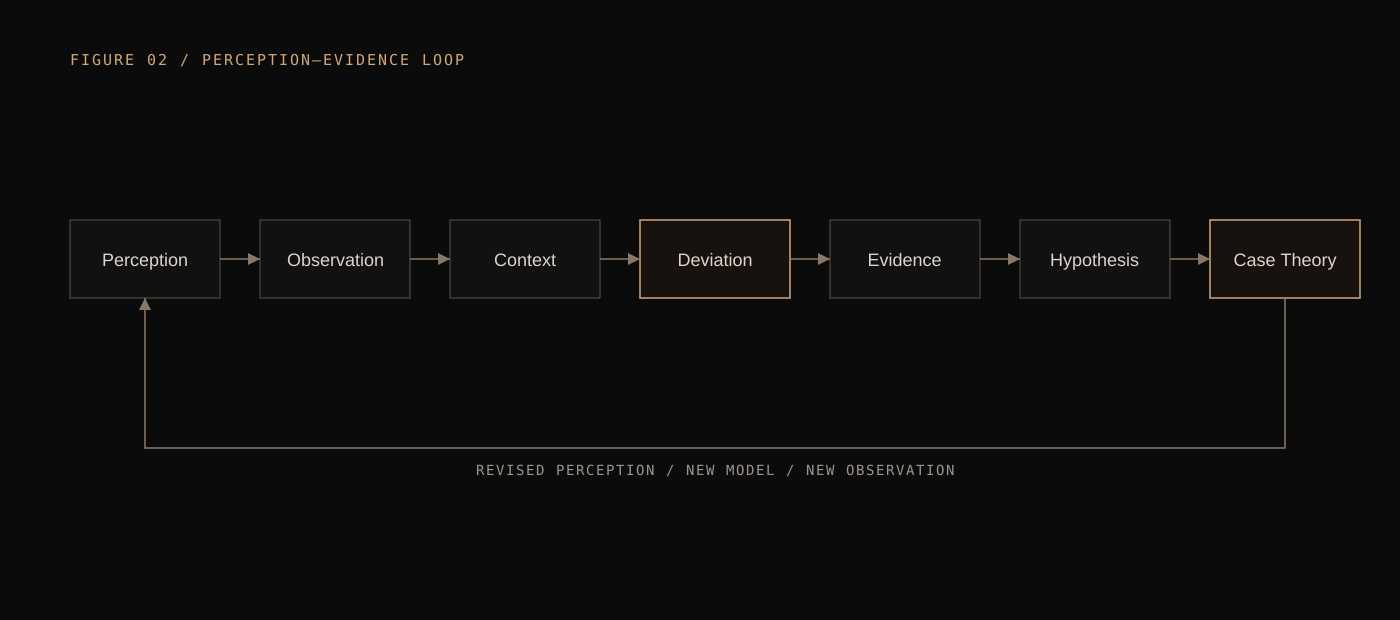
The resulting game loop is epistemic rather than merely collectible: perceive, contextualize, detect deviation, test evidence, form a provisional model, then perceive again.
This is a working reference trail, not an exhaustive bibliography.
- Donald D. Hoffman — Interface Theory of Perception.
- Donald D. Hoffman and collaborators — evolutionary models comparing fitness and veridical perception.
- Donald D. Hoffman & Chetan Prakash — formal work on conscious agents / conscious realism.
- Óscar Olea — Configuración de un modelo axiológico para la crítica de arte.
- Óscar Olea — later work connecting critical judgment, information, originality and historical context.
The project uses these materials as research and artistic inspiration. Their contested scientific or philosophical claims are not presented here as settled fact.