Perception as interface
Donald Hoffman's Interface Theory of Perception is used as a design provocation. The useful distinction is computational: underlying state and experienced rendering need not be identical.
Read theory notes →WORKING PAPER / PUBLIC RESEARCH LAYER
Perception, memory, evidence, and interactive worldbuilding
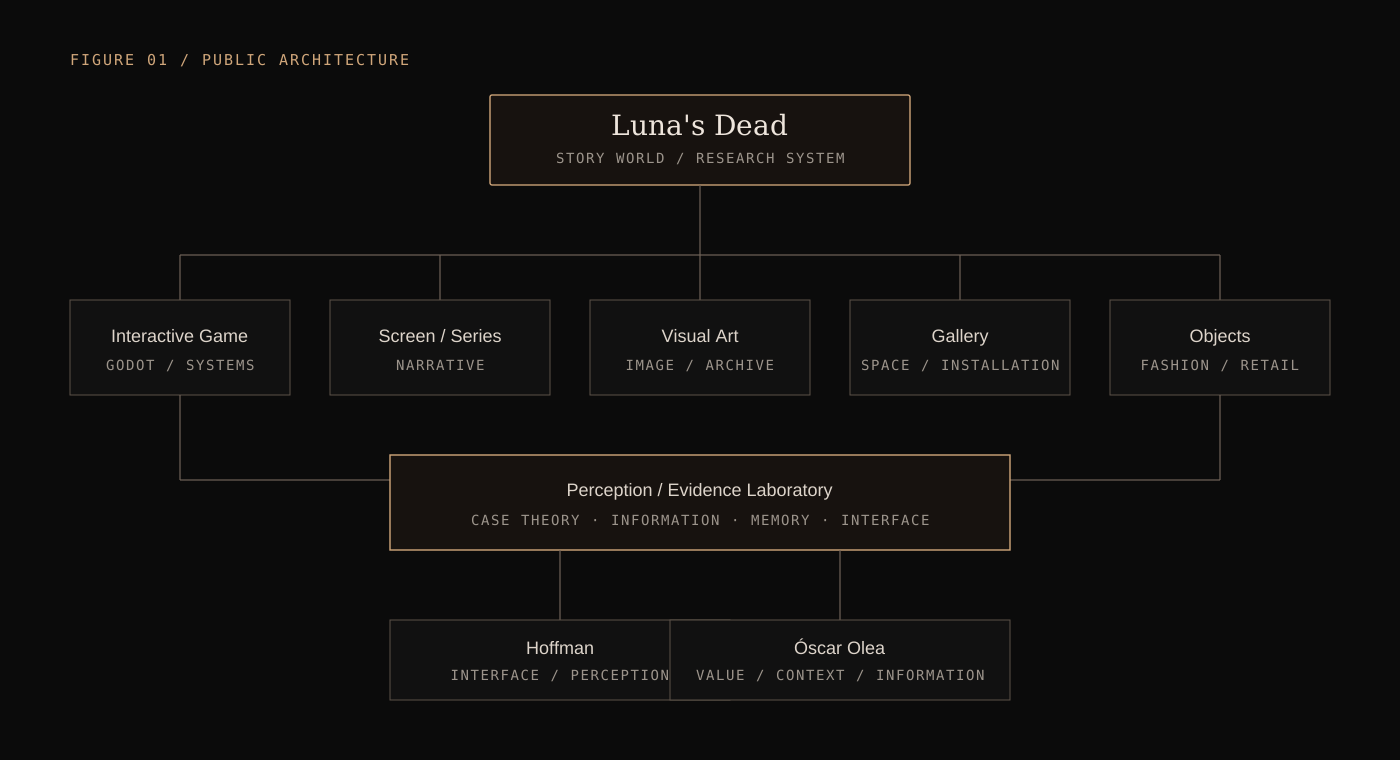
Luna's Dead is an evolving story-world and game-design project that uses theories of perception, information, and value to explore how players build meaning from incomplete representations of reality.
The project follows Luna, an attorney who survives a near-death event and begins perceiving contradictions between the ordinary world and another representational layer associated with the dead. Rather than treating philosophy as exposition, the project translates theoretical questions into systems: observer-specific rendering, evidence comparison, environmental anomaly, memory networks, and provisional case theory.
This public site documents the theoretical framework, system design, visual experiments, and working notes behind the project. Complete story canon, unreleased scripts, mystery solutions, and confidential collaboration material remain outside the public repository.
When every observer sees through an interface, how do we decide what deserves to be believed?
The project does not assume that truth is impossible. It assumes that truth is not simply available. A document, memory, physical trace, institutional reconstruction, or ghost testimony may each be meaningful without being complete.
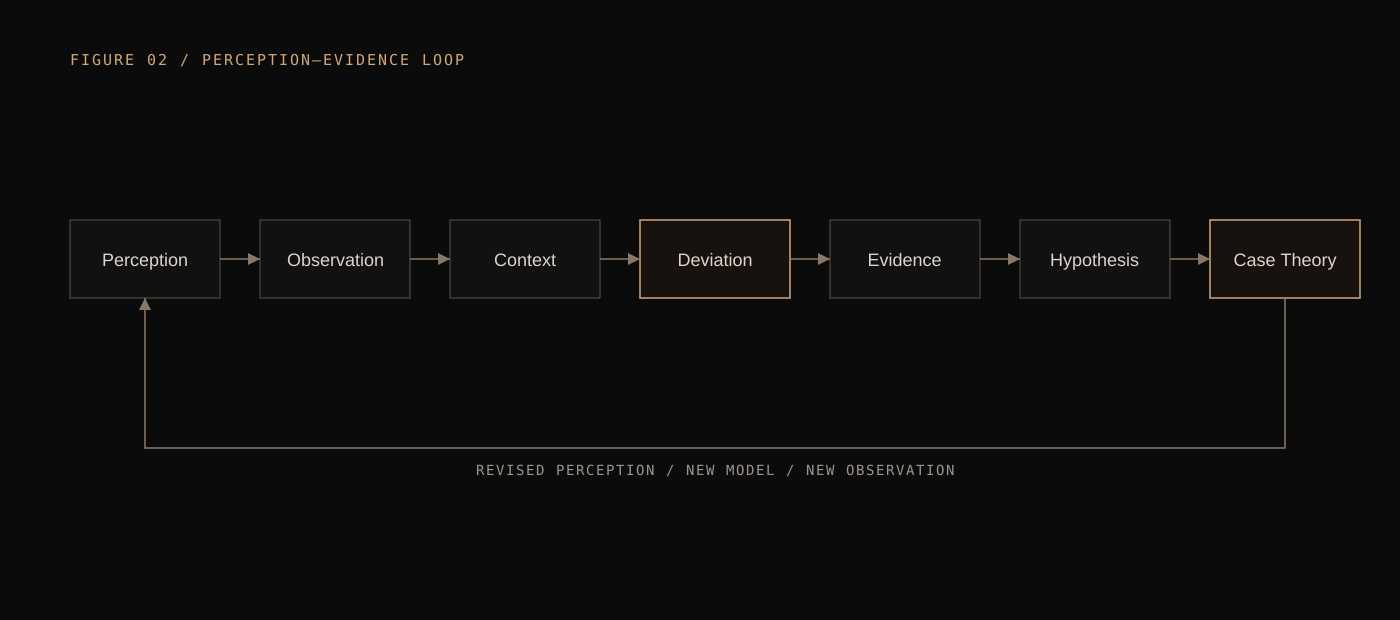
Donald Hoffman's Interface Theory of Perception is used as a design provocation. The useful distinction is computational: underlying state and experienced rendering need not be identical.
Read theory notes →Óscar Olea's axiological and information-oriented work inspires a complementary mechanic: an object becomes significant through its relation to expectation, context, deviation, and the system surrounding it.
Read Olea notes →THE ROOM DOESN'T FIT
An early playable investigation takes place in a preserved 1980s motorcycle garage associated with Zephyr and Los Muertos. The room contains overlapping versions: police reconstruction, physical traces, memory, archival records, ghost testimony, and Luna's evolving case theory.
The first defensible conclusion is deliberately restrained:
The game does not reward the player for pretending to know more than the evidence supports.
Read the systems framework →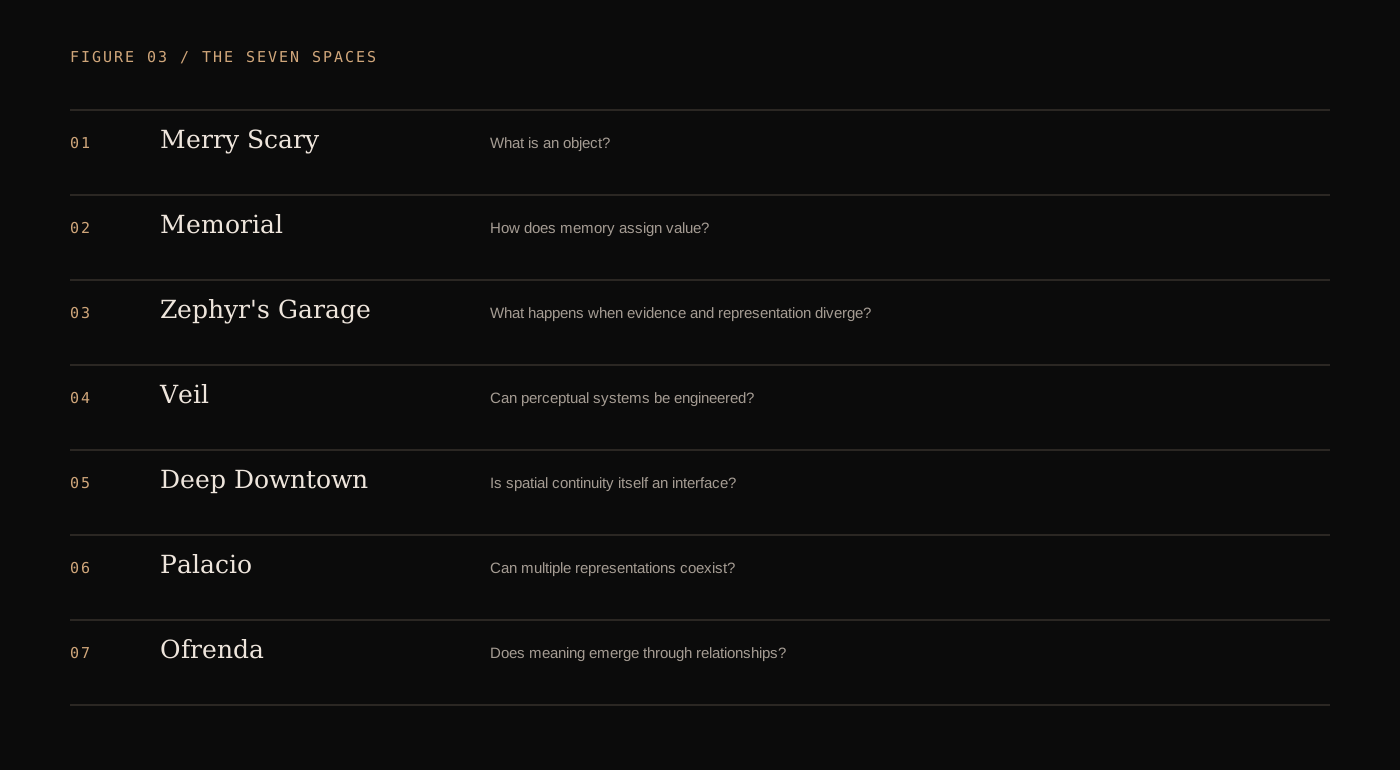
The project is also testing whether a fictional object can function simultaneously as story evidence, game asset, costume, gallery artifact, and physical edition. This is the basis for future scoped collaborations in fashion, motorcycles, objects, photography, sound, film, and installation.
October 2026 — active development.
References to consciousness, perception, information, spacetime, or metaphysics are treated as research and artistic inspiration, not as declarations that contested theories have been scientifically established.
© 2024–2026 Emma D. Enriquez. Public research layer. Private canon maintained separately.