Merry Scary
What is an object?
Commerce, art, archive and anomaly occupy the same environment. The player learns that an object can have simultaneous aesthetic, narrative, evidentiary and commercial states.
SECTION 03 / SPATIAL FRAMEWORK
The spatial sequence is also an epistemological sequence: each environment changes what counts as evidence and what the player is capable of interpreting.
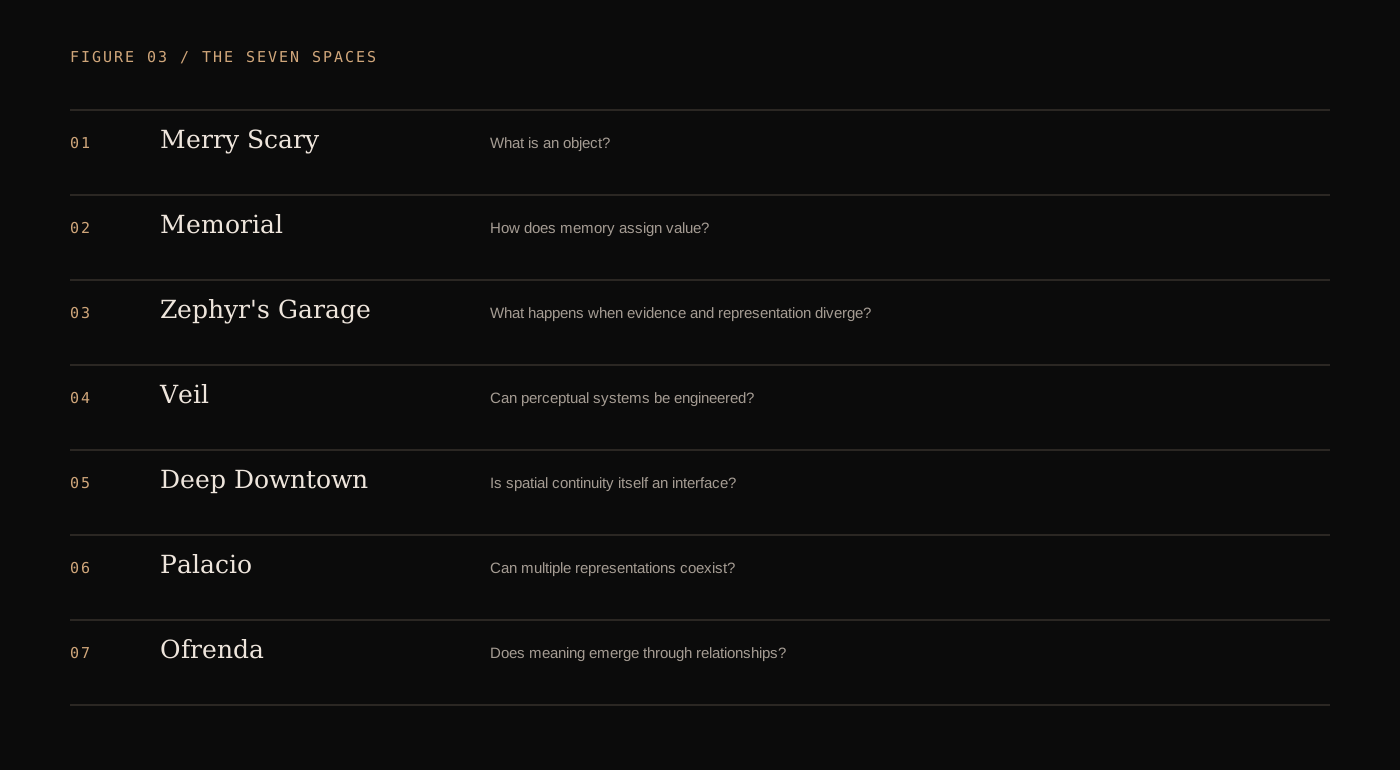
What is an object?
Commerce, art, archive and anomaly occupy the same environment. The player learns that an object can have simultaneous aesthetic, narrative, evidentiary and commercial states.
How does memory assign value?
Names, photographs, offerings and stories make relational memory visible. Identity begins to look less like a file and more like a network.
What happens when evidence and representation diverge?
The player learns environmental grammar, contradiction, and the discipline of provisional conclusions.
Can perception be engineered?
The philosophical problem becomes institutional: if interfaces can be built, they can also be controlled, monetized and used to determine which representations become authoritative.
Is spatial continuity itself an interface?
A subway metaphor becomes increasingly impossible. Transportation may be the form Luna's mind gives to crossing rather than literal infrastructure.
Can multiple representations coexist?
Memory, image, performance, fashion and the social world of the dead meet without collapsing into one final account.
Does meaning emerge through relationships?
Earlier objects return with altered significance because the network around them has changed. Meaning is relational rather than merely intrinsic.
Each space teaches a new way to read the world. The final sequence therefore depends on accumulated interpretive structures, not simply accumulated inventory.